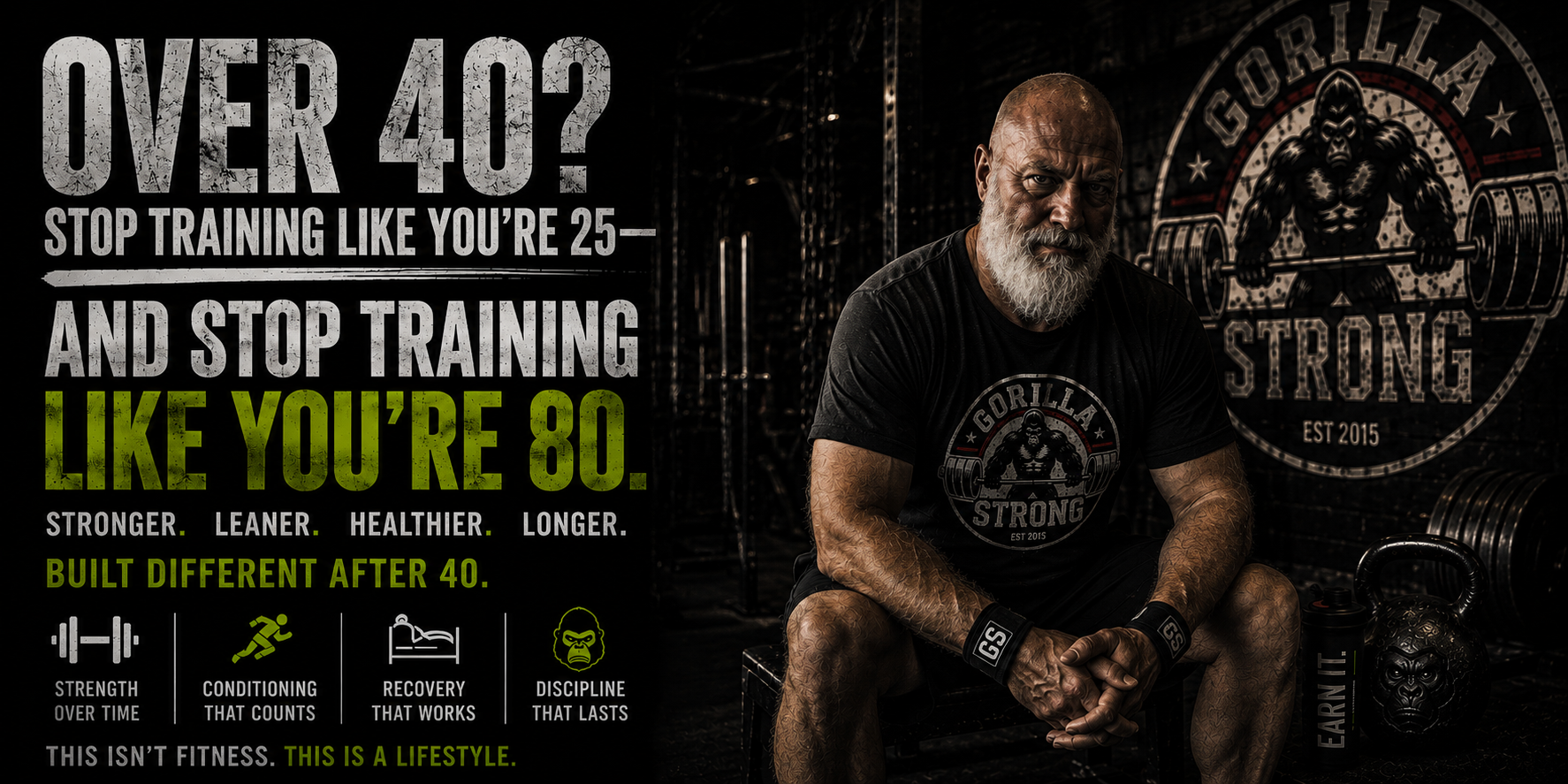
There is a strange thing that happens when people cross 40. One side tells them to slow down, protect themselves from everything, and accept getting weaker as part of aging. The other side keeps chasing the exact same punishment they survived at 25—max effort every day, junk volume, poor recovery, and no real plan.
Both approaches miss the point.
After 40, the goal is not to become fragile. The goal is to become harder to break. That means preserving muscle, building usable strength, keeping an engine, moving well, and recovering well enough to do it again next week, next month, and next year.
Strength Is No Longer Just About Looking Strong
Muscle and strength become more valuable as you age, not less. Resistance training gives your body a reason to preserve muscle and bone while maintaining the physical reserve you need for work, travel, stairs, carrying, getting off the floor, and everything else life throws at you.
That does not mean everyone needs to chase a one-rep max. It means your program should include progressive versions of the basic patterns: squat, hinge, push, pull, carry, brace, and move.
Barbells are useful. So are dumbbells, kettlebells, sleds, machines, sandbags, farmer handles, and bodyweight movements. The tool is secondary. The progression is what matters.
Stop Training Like You’re 25
At 25, you could often get away with bad decisions. You could sleep five hours, eat whatever was nearby, turn every workout into a competition, and somehow show up again tomorrow.
After 40, poor decisions collect interest.
That means training hard still belongs—but random punishment does not. Every hard session needs a reason. Volume has to fit your ability to recover. Technique matters. Warm-ups should prepare you for the work instead of exhausting you before it starts. Progress should be earned rather than forced.
Hard training is not the problem
Unmanaged training is. The strongest adults I see are not afraid of intensity. They simply understand that intensity is a tool, not a personality.
And Stop Training Like You’re 80
The opposite mistake is treating 40, 50, or 60 like a medical diagnosis. Unless you have a specific limitation that requires modification, getting older does not mean abandoning heavy resistance, challenging conditioning, power, or athletic movement.
Scaling is not surrender. Smart exercise selection is not weakness. And “age appropriate” should never become code for never doing anything difficult again.
Your body adapts to the demands you consistently place on it. If you never ask it to produce force, it gets worse at producing force. If you never elevate your heart rate, conditioning fades. If you stop challenging balance, coordination, and range of motion, those qualities do not magically preserve themselves.
Keep the Muscle
For adults over 40, muscle is not vanity tissue. It supports strength, metabolic health, joint function, physical independence, and the ability to tolerate life.
A productive program should train the major muscle groups multiple times across the week and provide enough resistance to create adaptation. You do not need endless exercises. You need quality work, repeated consistently, with loads and repetitions that gradually move forward.
Nutrition has to support the mission too. Adequate protein, enough total nutrition to recover, hydration, and a body-composition strategy that fits the goal all matter. You cannot out-program chronic under-recovery.
Conditioning Is Part of Strength
Being able to lift something heavy once is useful. Being able to recover and continue working is even more useful.
That is why conditioning is part of the Gorilla Strong approach. Rowing, SkiErg work, air bike intervals, sled pushes and pulls, carries, walking, and controlled aerobic work can all build the engine without turning every day into a death march.
For some people, HYROX-style training is an excellent goal because it combines running and functional work. For others, lower-impact machines and loaded carries are a better starting point. The method changes. The objective does not: build a heart and lungs that can support the body you are trying to create.
Mobility: Own the Range You Need
You do not need a 45-minute stretching ritual before touching a weight. You need enough usable range of motion to perform your training safely and efficiently.
Mobility should be specific. If your ankles limit your squat, work on the ankles. If overhead range is restricted, address the shoulders and upper back. Then reinforce that range with controlled strength.
The goal is not to become flexible for its own sake. The goal is to move well enough to stay capable.
Recovery Is Where Adults Win or Lose
Recovery is not an excuse to avoid work. It is what allows the work to produce results.
Sleep, protein, calories, hydration, stress, training frequency, and total volume all affect how much you can handle. When recovery is poor, the answer is not always “train less.” Sometimes it is better exercise selection, fewer junk sets, more intelligent conditioning, or simply stopping the habit of maxing out every time you feel good.
The target is repeatable hard work. A heroic Monday that destroys Wednesday and Friday is not a great program.
Progression Beats Chaos
The internet can give you a thousand workouts before breakfast. That is exactly why so many people stay stuck.
Results come from progression: adding a little weight, earning another rep, improving technique, completing the same conditioning work with better control, recovering faster, or tolerating more useful work over time.
If the workout changes every day and nothing is tracked, you are collecting sweat—not data.
What Training After 40 Can Look Like
For many busy adults, three well-designed full-body strength sessions per week can build an excellent foundation. Add appropriate conditioning, walking or easy aerobic work, and recovery around that structure.
- Strength: progressive squats, hinges, presses, pulls, carries, sleds and single-leg work.
- Muscle: enough weekly volume to maintain and build lean tissue.
- Conditioning: a mix of sustainable aerobic work and harder intervals.
- Mobility: targeted work that improves the movements you actually use.
- Recovery: planned around your real life, not an imaginary athlete schedule.
That plan should change with training history, injuries, goals, schedule, and current capacity. That is where coaching matters.
Why Coaching Matters More Now
You have less time to waste than you did at 25. Random workouts, endless restarts, and guessing what to do next cost months and years.
A good coach does more than count reps. Coaching creates a starting point, chooses the right exercises, controls progression, watches technique, adjusts the plan when life changes, and keeps you accountable when motivation disappears.
At Gorilla Strong in Macon, Georgia, we train adults who still want to perform. Some want personal training. Some thrive in semi-private training. Some want HYROX conditioning. Some need the Hybrid Gorilla Method. The format can change, but the standard stays the same: become stronger, fitter, more resilient, and more capable.
You Are Not Done
Forty is not the finish line. Fifty is not the finish line. Sixty is not the finish line.
But pretending you are indestructible is not toughness, and surrendering to weakness is not wisdom.
Train with intent. Lift heavy enough to matter. Condition your heart. Keep your muscle. Move well. Recover like it matters. Follow a plan long enough to see what you are capable of becoming.